Farmers See Clear Payoff in Precision Ag’s Practical Gains
A 2026 survey of North American growers shows precision ag tech is now an everyday tool, driven by measurable efficiency and cost gains, but barriers to adoption persist beyond price.
Precision Ag Adoption: Routine, Not Remarkable
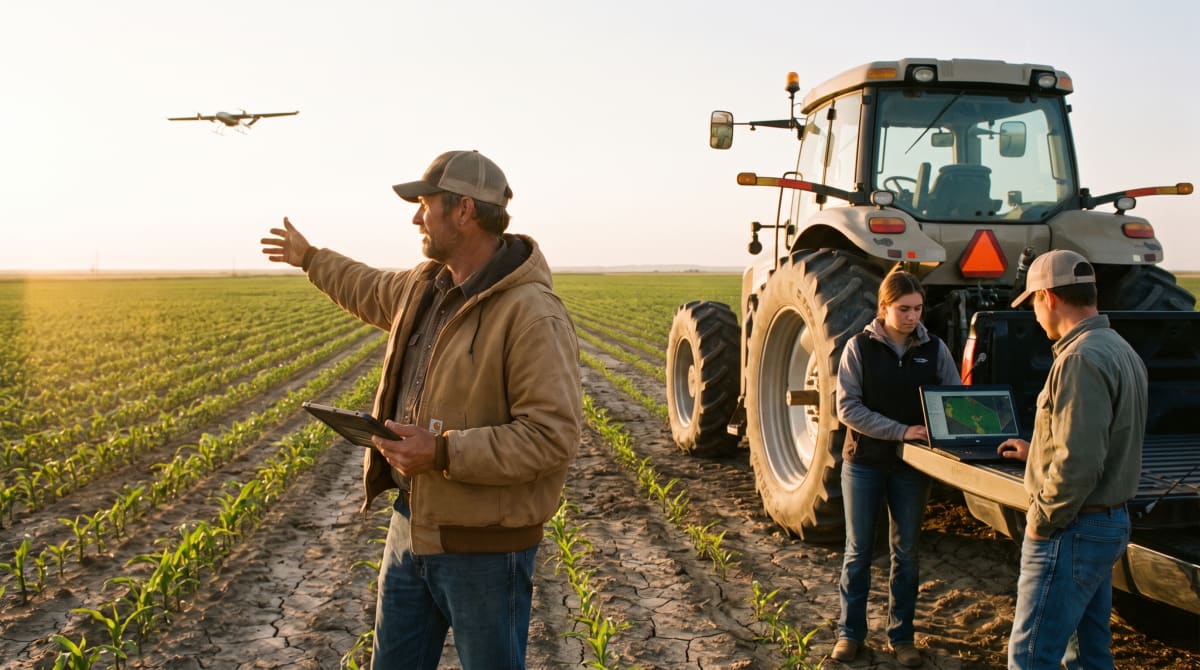
Precision agriculture has shifted from leading-edge experiment to daily reality on many North American farms. In a May 2026 survey of 217 U.S. and Canadian farmers cited by AGDAILY, 89% reported using auto-guidance on their equipment, and 71% called precision technologies important to their operation’s success.
These figures reflect the practical way many growers now view data-guided management. Rather than representing a leap into the unknown, most see their investments as a continuation of generational improvements. One farmer summed it up with: “We are eager to add [more] tech, learn to use it, and learn from it. … Keep the technology/automation coming, the [next generation of farmers] will use it.” The normalization is especially evident in regions with wide variability, like those farming in Arizona’s irrigated fields, Idaho’s varied potato terrain, and the sprawling row crop acres of Iowa. Here, auto-guidance, field mapping, and zone-driven applications are routine enough to be expected rather than showcased.
What Growers Value Most: Inputs, Efficiency, and Yield
Growers aren’t adopting new tools for novelty’s sake. According to the CNH Farmer Pulse data reported by AGDAILY, 74% of respondents named reducing input costs as their top driver for precision tech adoption. Labor efficiency followed at 70%. Only slightly behind, 59% pointed to increasing yields.
Tech investments must deliver a measurable return. The survey showed that:
- 62% of farmers using precision tech say it provides moderate or extremely high value.
- Over half plan further investments in the next two years.
This pattern matches what’s visible in practices like drone-enabled aerial scouting, NDVI mapping, and precision application. The immediate impact, using less fertilizer on poor-performing acres, trimming fuel use with efficient machine routes, applying nutrients or biologicals only where data shows crop stress, brings a quick bottom-line return. Even in diverse specialty crops in Hawaii or high-value potato ground in Idaho, the value is in documentation, variable-rate capabilities, and operational clarity.
Barriers Beyond the Price Tag
Despite rising adoption, not every farmer sees the path as smooth. Cost remains the main hurdle, cited by 56% as the biggest barrier to wider use. Closely following are doubts about ROI (36%), need for more training (21%), and concerns about connectivity (13%).
Ease of use, once considered an afterthought, now shows up as a noteworthy barrier (11%). The new challenge is not collecting data, the numbers show that’s largely solved, but managing it in a way that doesn’t bog down operations or create more problems than it solves.
In practical terms, this means transition points matter: turning field imagery into in-season decisions, integrating data streams into a single digital record, and acting on analytics in tight application windows. For operations facing shifting weather or market volatility, simplicity becomes a critical feature, not just an afterthought. As one product manager commented in the survey, the focus has to be “helping farmers spend less time managing technology and more time putting it to work.”
ROI: Clarity Without Overstatement
The value proposition is now more sharply defined. Whether in variable rate seeding, drone-planned field scouting, or site-specific record-keeping, the measurable returns are what push adoption. But growers remain skeptical of “silver bullet” claims. The best results often come not from having the newest tool, but from knowing how to integrate it with boots-on-the-ground practices and knowledge of field-level variability.
Documenting each year’s returns, variability, and lessons learned is an expectation for those who plan to scale up technology adoption. The survey illustrates that the thought process is less about leapfrogging competitors and more about building steady, quantifiable improvements.
The Road Ahead: Beyond Saturation, Towards Integration
Market saturation isn’t the endpoint. The CNH Farmer Pulse suggests future precision ag value will come from technologies that are less technical for the user, more unified, and require minimal time and training. Connectivity, especially critical for drone flight planning, live field uploading, and remote analytics, remains a sticking point in rural zones, but the trend is toward seamless data flow and integration.
Most notably, the survey’s findings point away from a single do-it-all platform and instead toward open systems where field data from multiple sources flows into actionable insights. Growers want documentation that doesn’t double their digital workload. They need clear, easily digestible analytics that directly inform input decisions and operational planning.
Conclusion: Where Analytics and Field Reality Meet
The results of the 2026 survey underscore that for most growers, precision ag is not about chasing the latest gadget or software trend. It’s about everyday field decisions: targeting fertilizer where imagery shows crop lag, guiding applicators by sub-inch GPS, trimming overlap, and keeping records in ways that support season-over-season improvement.
Adoption continues to hinge on clear ROI, trusted simplicity, and the ability to connect technology with the unique realities of each operation, from irrigated Arizona valleys to variable Iowa hillsides. As more growers document value, not just data, the role of field intelligence platforms will only deepen, provided they continue to make the complex simple enough for any grower to implement and trust.
Source: https://www.agdaily.com/news/farmers-point-to-value-of-insights-that-precision-ag-delivers/